Sense of Decency

Listening to others, seeing things through their eyes.

By DENNIS HARROD

Ken Lindblom is hoping no one throws a brick through his window. He has no reason to think anybody will, but when you’re a small-town newspaper editor, people sometimes take exception to strong opinions. And when you run stories with headlines such as “The Trump Dictatorship Has Begun,” tempers might flare. 

Since taking over the Hi, Neighbor a couple of years ago, Lindblom has taken the free weekly publication in a new direction, generally leftward. Or more specifically, anti-Trump ward.

“Some people are disappointed,” he says of the change in approach. “But most comments I get are positive.”

“I get an occasional email and get called a mentally ill liberal, which I think to them is redundant.” The issue of redundancy brings out the editor in him. “Maybe I should edit the letter and send it back with corrections .…”

Many of the letter writers don’t want their views published. “I always ask them: ‘Is this for publication?’ and they say ‘No, it’s just for you.’”

He does occasionally get letters to the editor for publication and he publishes them. “We get one or two letters that are pro-Trump, but most of them aren’t. I guess that’s because of who the readership has become.”

The Trump Dictatorship column did not generate any immediate response. “So I don’t know if people aren’t reading it or what. I got a few thank-yous from people who agree, so we’ll see.” This is where he notes that he hopes not to get a brick through the window.

He did lose a couple of advertisers a year or two ago. “I published a couple of articles about LGBTQ issues; one was on health care and one was on bullying, and I had a couple of advertisers pull out; they didn’t want to see that in the paper. So, OK, well, good luck to you. You’re welcome back any time.”

Other recent articles written by Lindblom have dealt with the Supreme Court’s consideration of whether elementary-school student should be able to opt out of instruction that includes LGBTQ+ themes, and whether empathy is a weakness or a strength. The latter was written in response to Elon Musk’s assertion that “the fundamental weakness of Western civilization is empathy.”

He says his goal was never to have a political paper. “It’s supposed to be a feel-good, pro-business, community-building paper. But right now, I can’t be silent.”

Hi, Neighbor editor Ken Lindblom

“I know a lot of people, frankly a lot of family, and they’re supporting Trump but they can’t give a reasonable explanation of why they buy into with these oddly outsized social arguments, you know, like transgender people are somehow threatening all of us, which is ludicrous, and others really seem to believe that he would be a financial genius and take this country from being really strong to being even stronger. They certainly think of themselves as good ethical people, but the hatred has been tapped and it’s like … cognitive dissonance.”

In a Feb. 10, 2025 article titled “Revolution or Coup, the Trump Administration Moves Forward,” Lindblom noted that he had talked to many Trump supporters before the election but found it difficult to get specific answers on what people wanted and/or expected. He said he only got general answers about bringing prices down or controlling immigration. He asked how we can evaluate the Trump presidency if no one has specific expectations. He wrote that he took over the Hi, Neighbor “because I wanted to start conversations about Madison County. Most of you who voted in 2024 did so for President Trump. What do you think so far? What changes have you experienced? Let us know.”

Before buying the Hi, Neighbor, he taught, first in public schools and then in college. He met his wife in a Shakespeare class at SUNY Albany. “The class was on the comedies, and you know how all the comedies end? They all end with a marriage, so we were forced into it. Luckily, it worked.”

He did his doctorate at Syracuse University while his wife taught at Utica College so they both knew and loved Central New York and wanted to be able to spend summers here. They found a place on the water in Erieville and, although “it took everything we had,” they were able to buy it and get away from Long Island when they weren’t teaching.

Then, in the spring of 2022, while he was on sabbatical and his wife was on leave, he saw the announcement that Hi, Neighbor was for sale. “I texted my wife a picture of the article and I said this seems perfect because I’ve been an editor of journals, I worked on my college paper, I was advisor to the high school newspaper where I taught, so I had that background.”

She told him to go ahead.

He hadn’t yet retired from teaching, but he contacted the owner of the paper, Brent Selleck, who had been running it since the early 1960s. “I told him my background and he said: ‘Well, you’re going to take over the paper.’” Lindblom shakes his head. “He just informed me that this was happening.”

Lindblom wasn’t ready to commit, but after a two-hour conversation, and going on a delivery run with Selleck, he was ready. “He was right: it was a really good fit.”

Selleck was a great mentor, Lindblom says. Lindblom helped on the paper during Selleck’s final weeks, and then Selleck helped Lindblom through his first few weeks.  “It seemed amazing. Everything he said that first day was exactly how it was; he was completely right about everything.” 

The first year was hard because Lindblom was still teaching full time on Long Island. 

“But all I had to do was keep it alive,” he says, which he did for that year until he retired from teaching. He found people to handle the delivery of the paper and was able to do work remotely. “We never missed an issue.”

He’s written not only on politics, but other issues of personal interest such as attending rock concerts as he ages, a recent auction hosted by the CNY Aquarium Society (he calls his fish tank his “device” and watches it instead of staring at a computer screen), and exploring his “Viking roots” while eating chicken wings in local restaurants.

His optimism shows through everything he writes in spite of his concerns with the current state of affairs. 

“The Founding Fathers,” he says, “set up a pretty good working model of democracy; certainly we’re finding flaws in it, but this can strengthen democracy over time. I still believe in the power of logical argument.”

He says his doctorate in rhetoric and composition strengthens his belief in the power of logical argument. “I think we need to be better at understanding the emotional and psychological elements of persuasion, but I still think it can work…that’s what I do and that’s the only way I can behave in this kind of culture.”

“I’m not going to become a raging lunatic,” he adds. “Although it would be easier and more fun probably.”

Dennis Harrod is a co-founder of Sense of Decency and a good neighbor.

Hi, Neighbor has a print circulation of 2,800, and is distributed free every week throughout Madison County and parts of Onondaga, Cortland, Oneida and Chenango counties in Central New York. Photos by Dennis Harrod.

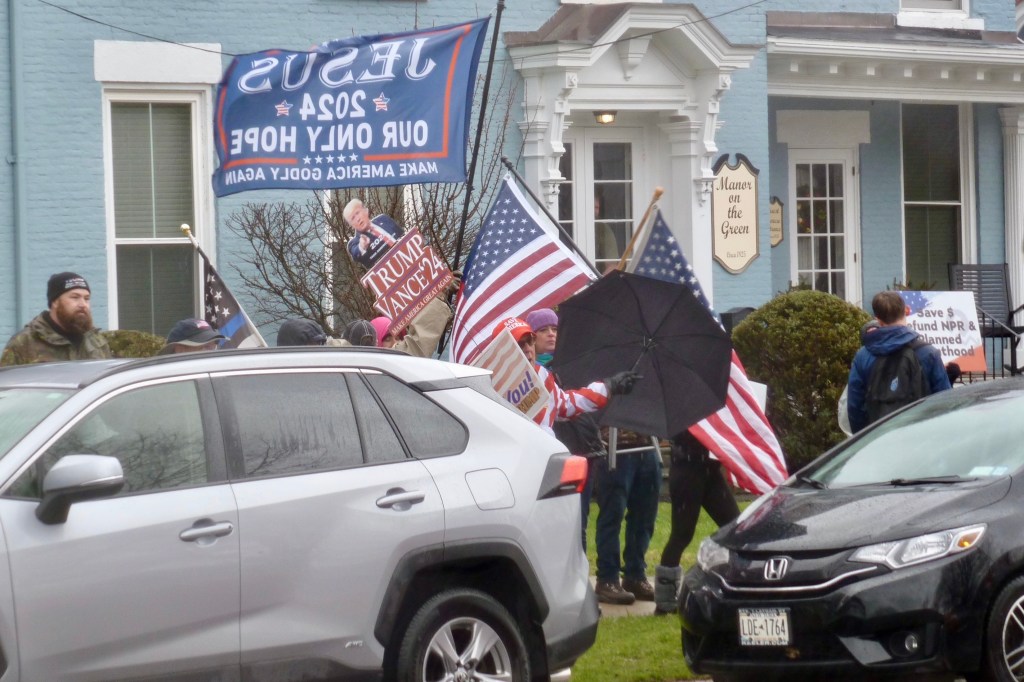
Counter protestors at a “Hands Off” rally against the Trump administration, April 5, 2025, Hamilton, N.Y. Photo © Dennis Harrod.

By DENNIS HARROD

I had an opportunity today to do what I always say I will do. But I didn’t do it.

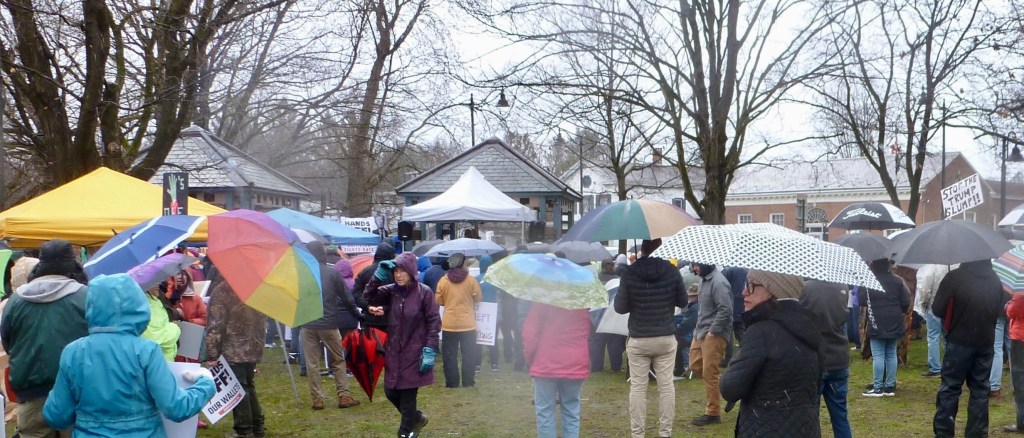
After nearly two hours in the rain at the Hands Off rally in Hamilton, N.Y. April 5, I was walking back to where I’d parked a couple of blocks away. As I walked east along the sidewalk, a group of three crossed and came onto the sidewalk about 20 yards in front of me. I didn’t know them, but I recognized the flag they carried. They were part of a group that had been on the other side of the road from the park where we were protesting the acts of the current presidential administration. 

I’d spent a lot of time watching the group of about two dozen counter protesters, who held up signs supporting Trump and saying “Don’t Tread on Me” and such. One of the flags said “Jesus, 2024, Our Only Hope, Make America Godly Again.”

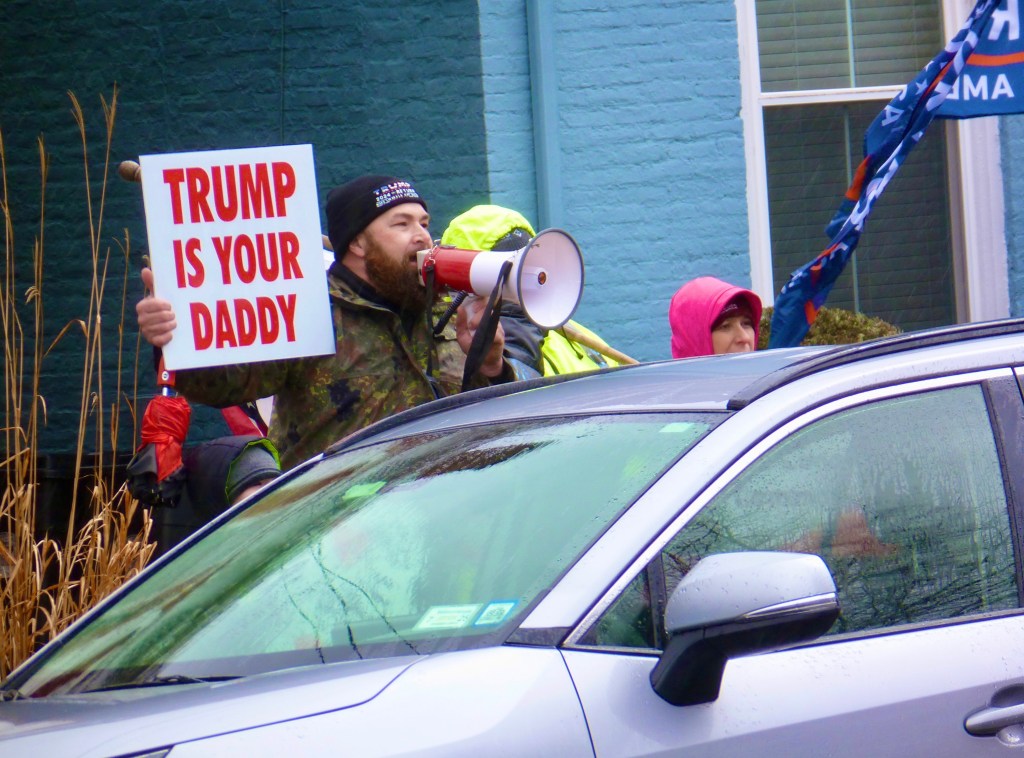
As people spoke or sang on our side of the street, the people across the street would occasionally interrupt by chanting through a megaphone “USA! USA! USA!” or “We Love Elon!” One guy held a sign that said, “Trump Is Your Daddy.” Indeed.

At one point, someone on our side passed out lyrics to “America the Beautiful” and we sang three verses. Everybody knows the first verse:

O beautiful for spacious skies, for amber waves of grain,

For purple mountain majesties above the fruited plain!

America! America! God shed his grace on thee,

And crowned thy good with brotherhood, from sea to shining sea!


We sang the second verse, as well, which I didn’t know and probably had never heard. I had to read from the handout:

O beautiful for pilgrim feet, whose stern impassioned stress

A thoroughfare of freedom beat cross the wilderness.

America! America! God mend thine every flaw.

Confirm thy soul in self control, thy liberty in law.

The third verse I had never heard. It was added to the Katherine Lee Bates’ original by Pamela Haines, which celebrates the working people of America:

O beautiful for working folk, who forged the wealth we see

In farm and mill in home and school, unsung in history.

America! America! May race nor sex nor creed

No more divide, but side by side, all rise united, freed!

A little further on, the group on the other side of the street sang “God Bless America” and then “The Star-Spangled Banner.” The latter is notoriously difficult to sing well, and they should have stuck with “God Bless America.”

Later, after we again sang “America the Beautiful,” including the new verse, the other side gave it a try as well. But nobody had blessed them with lyrics, so they only got the first verse in.

During the whole demonstration and counter demonstration, a guy in a big black Silverado bedecked with flags, American and Trumpian, circled the green with another, smaller truck behind him with a little DOGE sign on its door. The woman driving the second truck was on her phone each time as she drove by. Texting Elon, no doubt. A Tesla Cybertruck made the rounds a couple of times, too.

The guy on the bigger truck had some kind of music playing that I assume was supposed to be macho or intimidating or annoying, but I couldn’t identify it. At one pass, he yelled out the window “Communist!”, which I found ironic because I was holding sign that said, “Putin Owns Trump.”  I know Putin technically isn’t a communist, but a Red’s a Red in my book. 

As I caught up with the counter protesters in front of me I noticed that one of them was carrying the “Jesus” flag. As I walked past, I thought I should say something, start a conversation, maybe break down a barrier or two. They seemed like nice enough people, chatting among themselves about the harsh weather and, like me, wondering why they’d parked so far away. I’m always advocating reaching out to the “other side” and looking for what we share rather than what divides us.

But I didn’t. I walked by them and muttered something about the weather and kept going. I noticed they glanced at the sign in my hand and realized I was from the “other side,” but they agreed the weather was bad and I kept on going. As I got into my truck around the corner, I saw them getting into their car across the street from me. I still didn’t say anything and drove away instead.

I wish I’d stopped and talked to them, saying something like, “It’s nice to be on the same side of the street” or something equally inane that might have chipped away at the prejudices we feel toward those who don’t agree with us. Maybe they would have told me to drop dead. Maybe they would have said they’d been wanting to talk to someone like me. Maybe. But I’ll never know.

And all that afternoon and evening I thought about a profound essay by Jesus Colón, a brilliant and wise Puerto Rican writer who lived in New York in the middle of the last century. In “Little Things Are Big” he wrote about being in a subway station late at night when the only other people were a white woman and her children. The woman had a baby in one arm and a suitcase in the other. She had two other small children as well. Colón says he thought about offering to help her, but hesitated because he wasn’t sure how she would react, alone in a subway station late at night, if a Black man approached her. How would she react? In the end, he walked past her. And all the way home, he questioned his assumptions. He writes:

“Perhaps the lady was not prejudiced after all. Or not prejudiced enough to scream at the coming of a Negro toward her in a solitary subway station a few hours past midnight.

“If you were not that prejudiced, I failed you, dear lady. I know that there is a chance in a million that you will read these lines. I am willing to take the millionth chance. If you were not that prejudiced, I failed you, lady. I failed you, children. I failed myself to myself.

“This is what racism and prejudice and chauvinism and official artificial divisions can do to people and to a nation!”

Colón concludes:

“I buried my courtesy early on Memorial Day morning. But here is a promise that I make to myself here and now; if I am ever faced with an occasion like that again, I am going to offer my help regardless of how the offer is going to be received.”

I only hope that next time I will be as brave and as compassionate and as wise as Colón.

Dennis Harrod is a co-founder of Sense of Decency.


“Hands Off” rally against the Trump administration, April 5, 2025, Hamilton, N.Y. Photo © Dennis Harrod.

The house formerly owned by Cazenovia College and rented by the organization Cazenovia Welcomes Refugees. It’s empty for now. Photo © Dennis Harrod

By DENNIS HARROD

“For I was hungry, and you fed me. I was thirsty, and you gave me a drink. I was a stranger, and you invited me into your home.”

From the Gospel of Matthew

Across the globe, more than 43 million people are refugees, people forced to flee their own country. Their future is dismal, and their hopes are slim and getting slimmer. As of Jan. 27, 2025, The United States of America slammed the door shut on most of them. Donald Trump’s Executive Order of Jan. 20, 2025, says “entry into the United States of refugees under the USRAP (U.S. Refugee Admissions Program) would be detrimental to the interests of the United States.” With those words, hope dimmed across the world. But the lights have not gone out entirely. 

“There are endless examples of people doing kind things,” says Dave Holmes, who along with his wife Carolyn, was one of the founders of Cazenovia Welcomes Refugees. The group formed in 2017 to do just that, welcome refugees into the Madison County village. 

According to its Mission Statement, CWR aims to “create a welcoming place for everyone to live, work, go to school and enjoy recreation together.” The organization believes that “settling refugees as new Americans in Cazenovia will strengthen the civic fiber and compassionate heart of the community …. (and) add to the diversity and integration of our Cazenovia community.” According to 2023 Census data, the village of Cazenovia is 85% white with a $91,923 household income.

By 2018, CWR, working with InterFaith Works of Central New York (IFW), had helped a Kurdish family move to Cazenovia. The father had worked as a translator with U.S. forces in Iraq and neither he nor his family were safe there, says Carolyn Holmes. When that first home later became unavailable, a local woman purchased another house, specifically for the family to rent.

“It was total benevolence,” Dave Holmes says of the woman’s action. Buying the house and making it available “brought her joy,” Carolyn Holmes adds.

Now, the family is in the process of buying a house in Fayetteville, just over the Onondaga County line in the town of Manlius.

Meanwhile, CWR was able to work with Cazenovia College to refurbish a college-owned house on Lincklaen Street. In 2022, after countless volunteer hours and more than $60,000 of community-raised funds to pay for renovations, the house was ready to rent to another family, this one from Afghanistan. They had left their country when Kabul fell and found their way to the adjacent town of Manlius with the help of a U.S. Military officer who had served with the father in Afghanistan.

Their welcome was a story of community kindness and involvement. 

“Lots of people came in and volunteered in small and important ways,” says Dave Holmes. Staff members at the college helped whenever needed, students interacted with the family and babysat for the children. The local VFW post loaned tables for a fund-raising dinner.

Any fears of resistance from the community proved unfounded, says Pauline Cecere, former co-chair of CWR’s steering committee. “The community was welcoming,” she says. “There were no direct challenges.”

Carolyn Holmes says she had “half expected to see a nasty sign on a front lawn, but it never happened.” 

When Halloween approached, and CWR members realized that Lincklaen Street gets hundreds of trick-or-treaters, people made sure the family had candy to give out.

But then the college announced it was closing and another house had to be found. 

“When it (the college) collapsed, it was really disappointing,” says Carolyn Holmes.

Again, kindness prevailed, and a local couple made a house available to rent to the family.

Other acts of kindness stood out as well. Community Bikes of Hamilton, an organization that refurbishes bicycles and distributes them throughout Madison County, gave bikes to the children of both families.

“It’s another example of people coming out of the woodwork to help,” says Dave Holmes. “People in Madison County are really pretty nice, for the most part.”

He talks about other, countless acts of kindness along the way. He remembers how helpful and patient the Social Security administration was in helping get documents in order. “The first guy wasn’t very helpful, kept sending us to other departments,” he says. “But then we worked with a woman from Erieville who made sure everything was in order. She didn’t have to be so helpful.”

Since then, the family has bought a house and moved to Cicero, about 25 miles away. They had hopes of staying in Cazenovia and being admitted to The Landing at Burke Meadows, a new housing development that aims to provide affordable housing for seniors and families. But it didn’t work out and the family ended up buying the house in Cicero. This was a disappointment to CWR, whose members were so pleased with the welcome that the family had received. 

“It was a loss for the community,” Pauline Cecere says. 

But it’s also a sign of the program’s success, says Dave Holmes. The man has a job that allowed him to buy a house and put down roots in the United States. Unfortunately, not in Cazenovia.

The problem is and always has been a lack of affordable housing in Cazenovia. That is compounded by the lack of public transportation, making a driver’s license and automobile almost imperative. CWR members are even now driving a young Ukrainian to Onondaga Community College, 45 minutes away, for her classes.

An uncertain future

CWR’s future is a little uncertain. Aside from federal assaults on refugee resettlement, the organization is in the process of restructuring. It has redefined itself as a “starfish” organization, a decentralized structure in which there is no central command or leader but where individuals take responsibility for tasks and make sure they get done. One advantage is that as volunteers are lost for one reason or another, the organization can continue to function. Like a starfish, it can survive and regenerate more quickly than an organization that relies upon one centralized leader.

With no refugees coming in the foreseeable future, CWR will continue working in the community to lay the groundwork for resettling families when and if it becomes possible again. They will be meeting later this month to decide where to go from here. They will also continue working with InterFaith Works, which is facing its own crisis with the cutoff of refugees. 

InterFaith Works of Central New York was founded in 1976 to “build bridges of understanding among people of different religions and across racial divides,” according to its website. “Over the years, the agency added social service programs to address the needs of people who are vulnerable, low-income, targets of oppression, and refugees who arrive through the federal resettlement programs.”

This last part is important. IFW works with the federal government to resettle refugees who have been thoroughly vetted by the government. “It is well known, well documented and assured by the FBI, Homeland Security, CIA, and the United Nations that refugees who are moved out of camps to become New Americans are the most carefully screened and vetted immigrants on the planet,” says IWF on its website. It goes on to say that the language of Trump’s executive order “is about selectively excluding people for political purposes.”

In a January 22 newsletter from IWF, Executive Director Beth Broadway compares the efforts of the new administration to “death by a thousand cuts.” 

“The Executive Order is the first cut, and it is having its desired effect – the spreading of fear,” she writes.

‘The Push’

In response, immediately after the November election, IWF and other refugee resettlement agencies, along with the Biden administration, participated in “The Push” -– a full-scale campaign to bring as many refugees as possible to the U.S.

“Last week,” she writes in the Jan. 22 newsletter, agencies and the government “achieved a landmark goal of settling 6,000 people in just three months across New York State. These were people who were fully vetted, waiting for travel documents and many came to be reunited with their families.”

InterFaith Works alone settled more than 400 people during “The Push.” In the week leading up to the Jan. 20 inauguration, “we received 71 people representing 22 households,” Broadway writes.

Broadway also credits the countless acts of kindness that made it possible, from her staff and churches, temples and mosques, to volunteers who set up households, provided baby quilts and cleaned and donated more than 1,800 coats.

Trump’s executive order goes on to say that “Within 90 days of this order, the Secretary of Homeland Security shall submit a report to the President through the Homeland Security Advisor regarding whether resumption of entry of refugees into the United States under the USRAP would be in the interests of the United States.”

So, for 90 days from Jan. 27, uncertainty and fear govern the lives of refugees and those who provide for them. “It will be a big blow,” if the shutdown continues indefinitely, Broadway says. But IFW, like CWR, will continue. 

In April, when the 90 days are up, she hopes that the government will have assessed IFW’s work to be acceptable. “If not,” she says, “we’ll look for other funding sources.”

Other sources include the New York State Enhanced Service to Refugees Program, the Federal Department of Health and Human Services, foundations and of course private donors. Donating, she says, “is another way to protest.”

Broadway says she finds hope in her belief in “the core dignity of all human beings, a true source of decency.” They’ve gone through this kind of thing before, during the first Trump administration, and they survived. She finds hope also in the people that the agency attracts to its staff, “compassionate, kind and able to pivot whenever we have to to improve the lot of our fellow humans.”

“We may be on our knees,” she says, “but it’s because we are praying.”

For more information:

Executive Order Realigning The United States Refugee Admissions Program: https://www.whitehouse.gov/presidential-actions/2025/01/realigning-the-united-states-refugee-admissions-program/

InterFaith Works of Central New York: https://www.interfaithworkscny.org/

Cazenovia Welcomes Refugees: https://cazwelcomesrefugees.org/index.html

See also Utica: The Last Refuge for a look at success stories of refugee resettlement: https://www.lastrefugedocumentary.com/

Dennis Harrod is a co-founder of Sense of Decency.

Invisible man in the median, Seattle 2015. Photo © Jim McKeever.

By JIM McKEEVER

We create false worlds to survive.

I guess this has always been the case, human nature and all. But as humanity and collective empathy crumble around us, the false worlds we create have become more apparent. And more dangerous.

How much time, energy and money do we devote to things that distract us from the real world?

Sports. Netflix. Amazon. Alcohol. “Reality” TV. Social media and other addictions.

Meanwhile, wars, suffering, starvation and death are all around us — not exactly hiding in plain sight, given the reach of technology. On Instagram and TikTok these days, it doesn’t take much effort to find horrific photos and videos of torture, death and destruction.

But most of us look away, building a wall, as it were, around our hearts and minds.

Our souls as gated communities.

But walls and gates not only keep “bad” things out, they keep good things in — unused, wasted.

Is this self-preservation, or just plain selfish?

I’m just as guilty as anyone else. 

Every year I care way too much about my fantasy football team, a hobby even more questionable than investing huge amounts of emotion into a real team of millionaires that actually competes on a field.

I don’t have to look far to see people avoiding reality in other ways — gambling, obsessing over their personal appearance or the latest celebrity “influencer,” posting and sharing insipid comments on Facebook or Nextdoor.

Whatever happened to “live deliberately” and “The unexamined life is not worth living”? 

Are we that far gone as a culture, as a species, that most of us are just in it for ourselves?

Where is the line separating self-preservation from selfishness? 

For decades, bookstores have offered entire sections of shelves devoted to “Self Help.”  Why is there no such thing as a “Help Others” section?

Maybe we rationalize our distractions, these false worlds, as an attempt to seek “balance” in our lives. In some cases, that’s a defensible argument. 

There are good people among us who are in the midst of a particularly difficult time emotionally, physically or financially, and cannot cope with what’s going on out there.  

I have empathy for them — but not for those who simply “don’t want to deal with it” and go on their merry way, living what amounts to an unexamined, shallow life.

Which brings me to some simple suggestions on how to engage with and confront the real world.  

— Seek out photos and videos from journalists all over the world showing suffering and death caused by people in power. Don’t look away, as tempting as it is. This is reality.

— Initiate a conversation with someone who doesn’t look like you. Or live like you. 

— Find a community of people who are trying to do something good for others, especially those who don’t look or live like you.

— Don’t settle for simple answers that fit your existing beliefs. Question everything and everybody, especially those you agree with.

— Interact with people who are unhoused, the men and women holding cardboard signs at street corners.

— Become active in politics, at any level.

— Look up. Look around. Pay attention.

Joan Báez once said, “Action is the antidote to despair.” 

It’s also the antidote to fear.

Jim McKeever is a co-founder of Sense of Decency.

Labor Day 2023, Fayetteville, New York.

By JIM McKEEVER

This summer’s projects around the house have renewed my respect for those who do manual labor — the kind that some people refer to as “unskilled.”

Whether the term is used as an insult or as a lazy, clueless adjective doesn’t matter. It’s just plain wrong.

These thoughts came to mind, appropriately enough, on Labor Day, which arrived hot and humid as usual in Central New York.

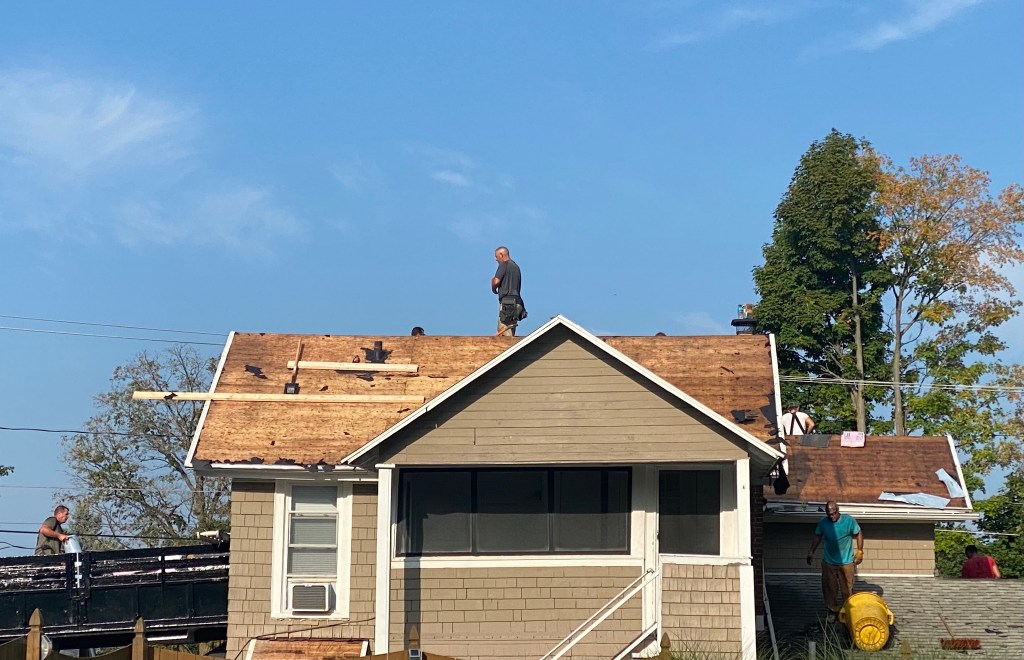
That morning I watched about 10 roofers attack the house next door, tearing off the old roof and laying down a new one, all in just a few hours — a good thing because it was already 80 degrees and muggy well before noon. I could see the sweat-stained shirts from afar.

Unskilled? 

You try wielding a roofing shovel and a nail gun in the blazing sun, laying down tar paper and shingles 20 or 30 feet off the ground on a steep pitch. 

I watched the transformation of my neighbors’ roof from my new patio, installed this summer by three men who dug it — by hand — and laid out an intricate pattern of decorative pavers (on top of layers of crushed stone) at a 2-percent slope so the rain doesn’t settle on the surface. 

Unskilled? No way.

These were not big, muscular guys doing what my father used to call “bull work.” The owner of the company recently turned 50, but has the stamina of the younger men who work for him.

A couple of weeks later, after I had painted my upstairs “office” (a grown son’s old bedroom), four professional painters arrived to paint the living room, kitchen and hallways. 

Painting is tedious work, and when I painted my office I cut corners, didn’t prepare the walls properly and missed some hard-to-reach spots. I rationalized that no one but me would ever notice things like the stray streak of blue on the white ceiling (which I later fixed because it was driving me nuts).

I’m glad the four pros who painted the downstairs didn’t check out my work. They spent more than a day patching holes with mesh screen, sanding and taping the walls and putting on just some of the first coat of paint. 

Unskilled? Not a chance.

The next day — a Saturday — they stayed late, chatting and laughing as they worked, putting on two coats of paint, three in some areas.  Like the patio guys, the painters were respectful of us and our home. I insisted they take their lunch break on the new patio. They clearly enjoyed working together and I enjoyed listening to them speak Spanish.

I have loads of respect for workers like these who grind it out day after day doing “bull work.” Any time I tackle a physically demanding project I’m usually creaky and cranky after Day One.

These folks just go on to the next roof, the next yard, the next house. One day just bleeds into the next.

The same goes with plenty of other occupations that require physical strength and endurance, as well as persistence, mental toughness and intelligence — farm workers, landscapers, housekeepers, construction workers, men and women on the factory floor and assembly line, etc. The list goes on.

Unskilled, no.

Under-appreciated, yes. 

Jim McKeever is a co-founder of Sense of Decency.

A trail on a ridge overlooking San Rafael, California. Photo © Jim McKeever 2015.

By JIM McKEEVER

I’ve long been a practitioner of “thin-slicing,” making assessments of a person within the first few minutes of an encounter. Author Malcolm Gladwell popularized the term in his 2005 book, “Blink: The Power of Thinking without Thinking.”

I immediately go through my mental checklist of the person’s politics, values, income level, their attitude toward me and how they likely treat other people in their lives. 

As a dear friend of mine used to say, I’m often wrong but never in doubt.

I should know better, especially because of my monthly grocery-shopping excursions with my friend James.

James is 57 and lived on the streets for a large part of his adult life. For years he slept in a doorway of a vacant building in downtown Syracuse, across from the state office building. Then, when James turned 50, a group of community members and advocates pulled out all the stops to find him a subsidized apartment, where he’s been ever since.

Once a month I take James grocery shopping. Occasionally we go to a home improvement store because he is meticulous about keeping his floor clean and wants a particular style of mop.

You wouldn’t think that if you’re a thin-slicer.

James lets his hair and beard grow freely.

He has put on quite a bit of weight since he’s been housed these last seven-plus years. He jokes about his added pounds, but is self-conscious about it. He favors a heavy Carhartt jacket and torn blue jeans, even on hot summer days.

James cuts quite an imposing figure, but he is one of the kindest and most polite people I know. He constantly greets and thanks cashiers and other store employees everywhere we go, and always leaves them with “God bless you.”

Sometimes he’ll catch another customer off guard with an abrupt question about the location of a product. Or a parent of a young child will be taken aback by his appearance — as happened recently when he greeted a small child sitting in a shopping cart with, “Hello, little one.”

I try to stick close to James in the stores, simply because I am wary of someone overreacting to his deep voice or a blunt question and creating a scene that could escalate. 

But in the five years or so we’ve gone shopping together, we’ve only had one negative encounter with another shopper. A man wearing a “camo” jacket — you can believe I thin-sliced that dude — didn’t like how much time James was taking to put some items into his cart. 

The man didn’t say anything rude, but he was clearly annoyed by having to wait to get his allotment of Chef Boyardee. His body language included angrily tossing several cans of pasta into his cart after James relinquished his spot in the aisle, then storming off toward the checkout lines. 

I guess James’ unkempt appearance, and my presence next to him, didn’t clue him in that James was making sure he had enough food to last the month. 

Our most recent shopping trip included a side trip to a home improvement store. (Yes, James needed a new mop). 

I avoid patronizing this chain because too often I see stereotypes come true — large pickup trucks with Trump bumper stickers in the parking lot. Aren’t all these home improvement stores MAGA magnets?

We quickly found the right mop and headed to the registers, which of course are mostly “self-checkout” lanes that annoy me no end. (But why are drive-up ATMs OK?)

Like most businesses with self-checkout, this store had employees in the area ready to assist customers who need help using the system. 

To my surprise, the employees on duty that day were two women wearing hijabs and the company’s aprons over their flowing garments. The younger of the two, who couldn’t have been more than 16, helped James with the mop purchase and was as pleasant as could be.

Ever since that encounter, I’ve been wondering how certain types of customers treat those women in their hijabs — and acknowledging that my bias against national home improvement chains and their “typical” customers may be unfair.

I’m often wrong, but maybe sometimes I should be in doubt.

Jim McKeever is a co-founder of Sense of Decency.

The vacant former Majestic theater in downtown Brownsville, Texas.

By JIM McKEEVER

I spent the last two weeks of May at the US-Mexico border in Texas, volunteering with the humanitarian organization Team Brownsville, welcoming asylum seekers.

In those two weeks, we welcomed hundreds of men, women and children, providing food, clothing, hygiene supplies and occasional assistance with transportation to other cities.

The need is great, as these desperate people have fled danger and violence in countries all over the world.

A common complaint about people like me and organizations like Team Brownsville is, “We should help our own people first.”

Has anyone told them we can do both?

Every morning on my one-mile walk to Team Brownsville’s welcome center, I invariably passed at least three, sometimes more, people — American citizens, I’m sure — on this side of the border who are clearly suffering.

Each day I took something with me to distribute — a sausage biscuit from McDonald’s, a peanut butter-and-jelly sandwich, loose change or an extra dollar bill.

There were three “regulars” on my route. 

Most mornings outside the ironically named and boarded-up Majestic theater and Majestic Mall, a woman sat slumped over in a wheelchair. A necklace with a crucifix dangled from her neck. She wore a scarf on her head and appeared bald, but I wasn’t sure. She never asked for anything, and didn’t seem to be aware of her surroundings. I startled her one day by leaning in and handing her a $1 bill. I noticed some teeth were missing when she looked up to thank me. I have no idea how she got there each morning. 

I ran into “Brother Scott” three or four times — once he came into the Team Brownsville welcome center and asked for a pair of socks. “I’m just a homeless guy down on his luck,” he said. (Many unhoused people in the city know about the welcome center and that we have food and clothing there.)

Another day on the street Scott asked me for a cigarette. And on my second-to-last day in Brownsville he hit me up for a dollar for coffee. I had a few minutes before the welcome center opened, so we had time to chat. Scott is 50-ish, tall with short white hair. He had been a long-haul trucker and was familiar with the New York State Thruway and the exits for Syracuse, near where I live. He said he had been in prison in Texas for 10 years, had never had been in a fight and even served as an unofficial prison chaplain. 

“Do you know the shortest sentence in the Bible?” he asked me. 

“Jesus wept,” he said, answering his own question.

‘Shinedown’ walks with a friend in Brownsville, Texas.

The “regular” who intrigued me the most, however, was another white-haired man, just as tall and even thinner than Scott. His ruddy face seemed even redder and more sunburned behind a snow-white beard.

He carried a backpack, and I recall that his hands shook. 

I would see him at the McDonald’s where I went most mornings for breakfast. One day I gave him $3 so he could buy his own coffee, and he nodded a thank you as he sat down with it in a booth.

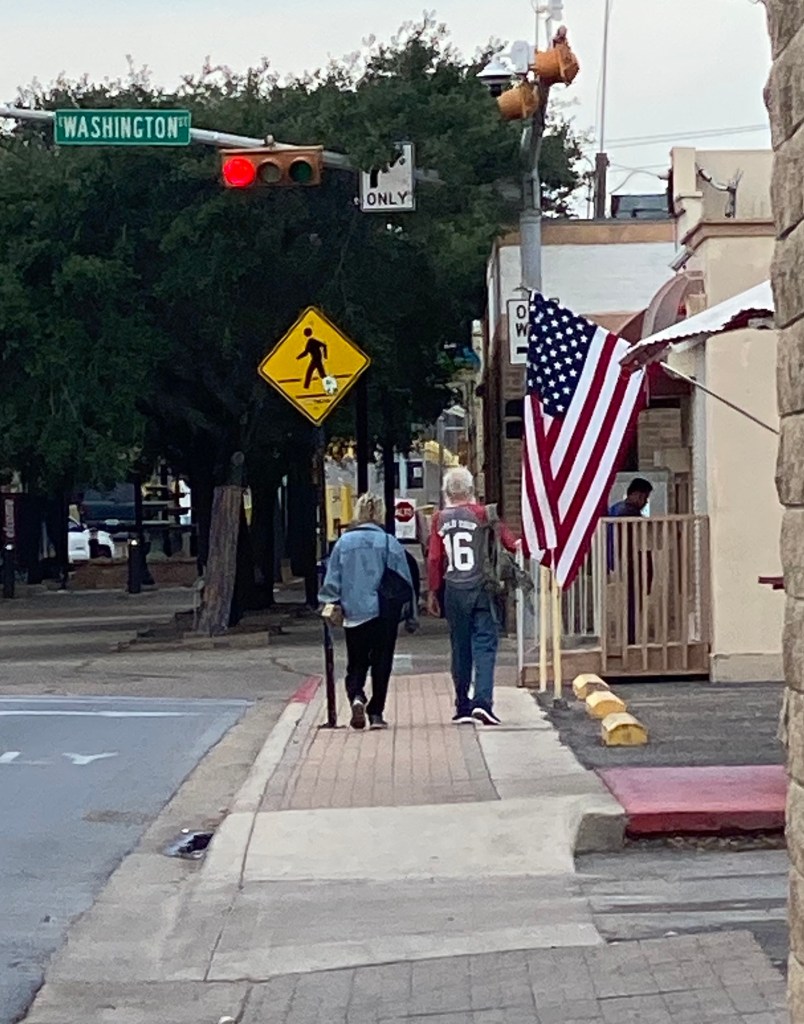
He often wore a long-sleeved shirt that read “World Tour 16” on the back. It took a few encounters to make out what the front of it said in script — “Shinedown,” a hard-rock band I had never heard of. In my head, that became the man’s name.

This particular McDonald’s is just four-tenths of a mile from the Gateway International Bridge at the US-Mexico border.

A few hundred yards farther into Mexico, 3,000 migrants from more than 20 countries are trying to survive under crude tarps in a claustrophobic encampment that turns to mud during heavy rains.

One morning, as I was getting ready to leave McDonald’s for my shift with Team Brownsville, “Shinedown” sat alone, as usual, in a nearby booth. He ambled up to the counter to get a refill on his coffee, which perhaps someone else had bought for him that day. 

I gathered up the remnants of my breakfast — oatmeal with apple slices, raisins and cranberries that came in individually sealed packets with instructions on how to open them, and a separately wrapped plastic spoon — and tossed the packaging in the trash.

I passed by the booth where “Shinedown” had been sitting  and noticed a tattered book on the table.

It was a Bible, open to the Book of Job. 

Jim McKeever is a co-founder of Sense of Decency. He travels regularly to the US-Mexico border to volunteer with humanitarian organizations that help asylum seekers and other migrants.

A woman looks through the border wall in Tijuana, Mexico, toward the United States. Photo © Bill McLaughlin 2019.

By JIM McKEEVER

The blue and yellow flags of Ukraine that flew so proudly in our communities last year have faded. Many have disappeared from front porches, yards and windows.

I guess we’re tired of reading and hearing about the war, more than a year after Vladimir Putin invaded the sovereign nation next door. (Perhaps he was tired of just imprisoning political opponents and journalists or throwing them out of six-story windows). 

In America, we have short attention spans.

The news these days is less about bombed-out buildings, grisly killings and resilient Ukrainians huddled in basements. The focus seems to have shifted to arguments over how many billions we’re spending “over there” — as if you and I can comprehend what a billion dollars means, whether it’s for tanks and guns or football stadiums. 

Perhaps it’s compassion fatigue. 

But I, for one, still fly a flag from my front porch.

Not a Ukrainian flag, mind you, but a rotation of flags representing several other countries where people are suffering and dying — not necessarily from the evil actions of a sociopath, but really, should that matter?

Guatemala. Nicaragua. Venezuela. Mexico. Haiti. 

I probably will add the flags of a few other countries that most Americans know absolutely nothing about and don’t care about.

Why is that?

It’s easier to vilify a madman like Putin than to take a clear-eyed look at what’s happening elsewhere, to try to understand why people are fleeing other countries — often courtesy of more than a century of American “intervention” for political or business reasons. (Neither major political party has clean hands.)

Apathy and our busy lives rule the day.

Ukraine is a relatively simple humanitarian crisis to follow — bad guy killing good people.

I begrudge the Ukrainians nothing. We should indeed welcome them with open arms. 

But if “the greatest nation on earth” can provide safe harbor for one group of people, what’s stopping us from doing the same for the men, women and children from other nations who are suffering and dying as well?

Could it be that the victims of Putin’s evil have white skin? 

I have written here before about the racism of U.S. immigration policy at work in Tijuana, Mexico, where Ukrainians were escorted en masse last year to the port of entry, literally walking past people with brown and black skin who had been waiting months, years for an asylum hearing in the U.S.

That’s why I fly these other flags.

More than 2,000 miles away at the southern border and here in my community, I have met people from those countries as well as others. They are kind and decent human beings, fleeing persecution and danger that we cannot comprehend. 

Two examples:

Last year on Mother’s Day, an asylum seeker from Cuba came through the line at the Team Brownsville welcome center in Texas, a stone’s throw from Matamoros, Mexico. He was on a video call with his mom back in Cuba, and when someone told him it was also Mother’s Day here, he held up his phone so that all the volunteers could wish her feliz Día de las Madres

The man could barely contain his joy and told us he was so grateful to be in America.

Closer to home, through a Central New York organization that supports immigrants, once a month I deliver boxes of food from a pantry to a family of four from Guatemala that works on a dairy farm. They work long hours in extreme temperatures and their income level qualifies them for food assistance.

Every month I am greeted by their beautiful 4-year-old son, who is eager to show me his toy cars and animals, and often grabs my hand — or wraps his arms around my legs — so that I will stay and play with him. He is no different from my grandchildren or any other child who deserves love and kindness. This family is no different from mine, or yours.

I think of that little boy when I fly the bandera of his family’s native land from my front porch. 

On windy days, the sky blue and white flag of Guatemala, and the more vivid colors of the other countries, flap in the breeze. The flags are large and hard to miss.

Most of my neighbors walk or drive past and don’t notice.

Or maybe they just prefer not to see. 

Jim McKeever is a co-founder of Sense of Decency. He makes regular trips to the U.S.-Mexico border to volunteer with groups that assist migrants and asylum seekers.

By DENNIS HARROD

A famous cartoon shows Robespierre about to execute the executioner on the guillotine. The implication is that Robespierre and his colleagues of the French Revolution have now executed everyone, and only the executioner remains. An inscription says “Here lies all of France.” 

I thought of that image this morning as I read of another killing. A six-year-girl and her parents were shot, apparently because a basketball rolled into a neighbor’s yard. Earlier this week, a man in Kansas City, Mo. allegedly shot a teenager who knocked on his door. And earlier, closer to home, a young woman in a car was shot and killed when the car she was riding in turned around in a man’s driveway. He allegedly shot her from the porch. And on and on. 

As I read the news again, I had an image of another pierre, this one Wayne LaPierre, the high-living head of the National Rifle Association. In my vision, LaPierre is surrounded by bodies, bodies of children, teenagers, adults, people of all kinds, and is holding a gun to his own head. The image in my vision says: “No one left to kill.”

This image bothers me because I (try to) wish no harm to anyone, no matter how vile they may appear. We are taught to believe that there is good in everyone, although it may be deeply hidden, and it is wrong to wish harm. But I’m not wishing him harm. Only that he and the politicians who so casually dismiss the crisis of gun violence behind the veil of the Second Amendment will wake up to the carnage that surrounds them. I actually admire the Tennessee lawmaker who said bluntly that he and his fellows would do nothing to stop the gun violence. At least he’s up front about it.

I wonder if the “Originalists” on the Supreme Court ever stop to consider that the originators of the Second Amendment were talking about single-shot firearms? 

Don’t get me wrong. I believe the Second Amendment gives me the right to own firearms, and I do own firearms and I do not want anyone arbitrarily taking them away. But I also believe the Second Amendment is not absolute any more than any other amendment. As a former journalist, I hold the First Amendment and its provision of a free press as sacred. But I know that there are limits to free speech, limits that come into play when that speech does demonstrable harm. When the suffering of the society at large outweighs the unbridled exercise of that right.

It’s curious that this belief is a cornerstone of “conservative” thought. “Conservatives typically contend that human moral imperfection leads men to act badly when they act upon their uncontrolled impulse, and that they require the restraints and constraints imposed by institutions as a limit upon subjective impulse,” writes Jerry Z. Muller in his book Conservatism: An Anthology of Social and Political Thought from David Hume to the Present. 

Muller’s anthology includes an essay from 1772 by Justus Möser: “On the Diminished Disgrace of Whores and Their Children in Our Day.” Möser argues that unwed mothers and their offspring should be shamed and shunned in favor of the good done to greater society by the institution of marriage. It should come as no surprise that Möser makes no mention of shame or opprobrium for the men who impregnated the women in the first place.

Whether you agree with Möser or not, the point is that even conservatives acknowledge that the good of society as a whole outweighs individual freedoms when those freedoms threaten to harm the society at large. So, if unwed mothers and their children (along with drag queens, gay people and immigrants) are such a clear and present danger to society, how can conservatives deny the blatant danger of unfettered firearms?

Again, I’m not saying that we should (or can) do away with guns in private hands, and, as much as it pains me to say it, I agree with the NRA’s flippant assertion that outlawing guns will leave only outlaws with guns. People break laws. That’s a fact. But we can take other steps to, at the very least, slow the slaughter. Red flag laws will identify some (not all) people who should not have deadly weapons at hand. Stricter background checks will again deter some (not all) people who plan to use firearms to harm others. Longer waiting periods are a minor inconvenience if they prevent even one violent, premature death. And, again, I agree with the NRA (God, it hurts to say that): enforce the laws we have and punish severely anyone who uses a gun, legal or otherwise, in the commission of a crime.

My Congressman, Brandon Williams, R-NY, in a recent town meeting, after affirming his belief that everyone has the right to own a military-type rifle, went on to list the things we shouldn’t do, that won’t work. But other than the above cited “enforce existing laws,” he had nothing to add and dismissed, almost as children, those in the audience crying out for something, anything to stop the flow of blood. Perhaps he’d pay attention if he knew that fewer than 10 percent of gun owners are members of the NRA. As one of the remaining 90 percent, I’m tired of being told there’s nothing to be done. Do something before all the states turn red — with blood.

Dennis Harrod is a co-founder of Sense of Decency.

“Face to Face: Portraits from the Precipice” by Bill McLaughlin will be on exhibit at the Earlville Opera House art gallery, Earlville, NY, from May 6 through June 24.

Editor’s note: Five additional portraits are below McLaughlin’s essay.

By BILL McLAUGHLIN

Many years ago while working on environmental issues and getting quite angry at the political and corporate entities that were contaminating the air and groundwater in the rural area where I was living, an experienced activist and dear friend gave me some advice that I knew was correct but with which I still struggle. 

She said something to this effect: We can hate what they do. We can hate the harm they cause and the decisions they make, we can hate their disregard for life and living systems, hate the toxic destruction they inflict — but we cannot hate them. They are human beings with the same flaws and faults but also containing the same wonder and potential. And just like us, they deserve respect and love. If we lose sight of that, then we have lost everything. 

We are all on a continuum and constantly evolving. The person we despise today because of their political views may someday become a catalyst for positive change. We know so little of each other’s motivations and influences.

As Miller Williams wrote in his poem, “Compassion” —

You do not know what wars are going on

down there where the spirit meets the bone

The precipice in the title of this project refers not only to where we stand today as a nation, but also to my own personal precipice. I confess to being outraged at the rise of Fascism, White Nationalism, Anti-immigration, Antisemitism, Anti-LGBTQ etc. and the heartbreaking increase of hate-fueled violence to which we are now in danger of becoming inured.

I’m disgusted by the assumptions and attitudes that inspire these ideologies. I despair that so many people are so easily manipulated and susceptible to incitement. So I find myself on the edge of the precipice, held back from the abyss by a thin thread from the past and those wise words of my activist friend. 

As always, it’s so much easier to hate a faceless group of people. We know from history that when we demonize others, we allow ourselves to be more easily manipulated, more readily bent toward hatred, violence and for some, atrocities. It has happened throughout history. It is happening today and it demands from us a serious, conscientious effort to overcome, to transcend.

Let me be clear: tolerance does not mean capitulation. But if we can neutralize the hate and avert the violence then perhaps we can prevail on that elusive “battlefield of ideas” where we can continue to advocate for universal inclusion.

You must fight others, but through peace, and through dialogue, and through education.” — Malala Yousafzai

So our challenge as we view these portraits is to find ourselves in each of these faces, and in so doing, discover our own humanity there and hopefully, our particular path back from the precipice.

About the Project

“Face to Face: Portraits from the Precipice” seeks to explore and acknowledge the diversity and richness of our Upstate New York community through portraiture. It is also a subtle reminder that as the voices of hatred and intolerance seek to divide us, that as a community, we share much more that unites us than separates us. 

More than 70 portraits were made at public events including county fairs, concerts and festivals over the last year throughout the rural areas of the Southern Tier. Several of the portraits were made more formally in private. Mostly, these portraits represent a random sampling of people I met who agreed to participate in the project.

As the forces that seek to divide us racially, politically and economically intensify, it is my hope that this project will help to foster tolerance rather than division; understanding rather than exclusion.

Selected portraits will be on exhibit at the Earlville Opera House art gallery, Earlville, NY, from May 6 through June 24. An opening reception is 1 to 3 p.m. May 6.

Bill McLaughlin

Bill McLaughlin is a painter and photographer who lives in New Berlin, New York. His work was featured in Sense of Decency in February 2021 with a review of “Living in Limbo: Portraits from the Border,” photos of migrants and asylum seekers Bill met in Tijuana, Mexico, in December 2019.